Find guideline-backed clinical answers directly within Empathia.
Emma Evidence is Empathia’s point-of-care clinical decision support and guideline retrieval assistant. It helps you quickly explore clinical questions using trusted medical evidence and guidelines—without leaving your workflow.
When to use Emma Evidence
Use Emma Evidence when you want to quickly explore questions such as:
What do current guidelines recommend?
Is additional investigation or imaging indicated?
What treatment options should I consider?
And more...
You can also ask follow-up questions to narrow or expand on an answer.
How to access Emma Evidence
There are two ways to use Emma Evidence in Empathia.
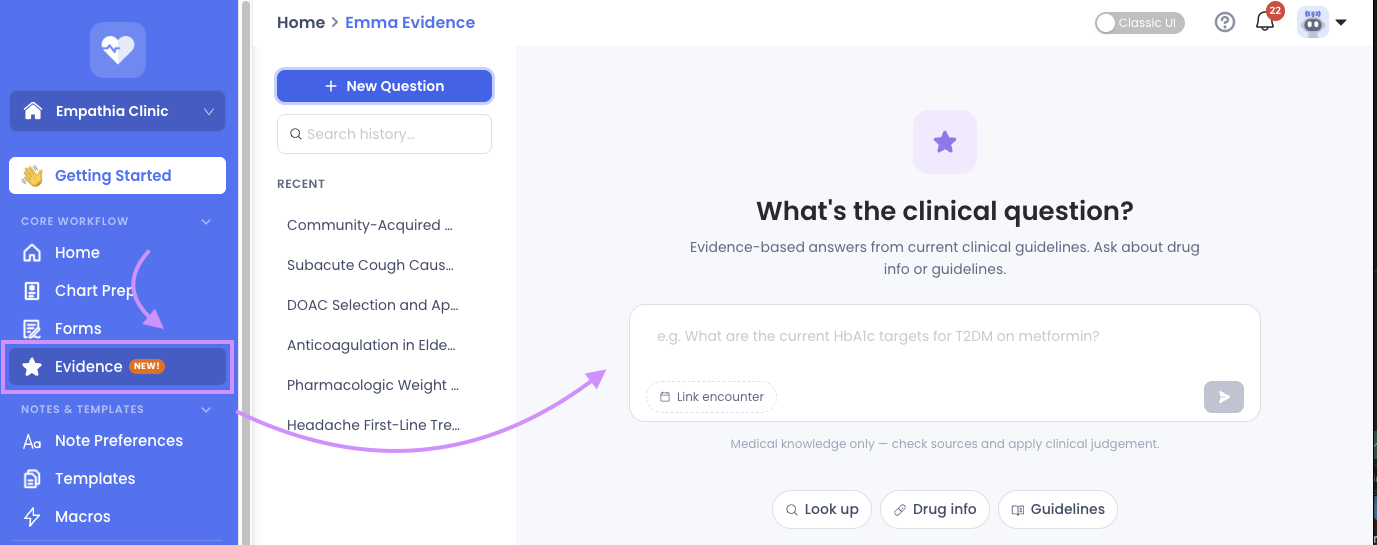
Option 1: Open Evidence from the main sidebar
Use the main Evidence page when you want to research a clinical question independently or choose an encounter to provide additional patient context.
Log in to Empathia.
Select Evidence from the main sidebar.
Enter your clinical question.
If needed, link the Evidence conversation to a patient encounter.
Review the response and its supporting citations.
This is useful for questions before or after an encounter, clinical learning, guideline review, or situations where you want to manually select the relevant patient context.
Option 2: Open Evidence directly inside an encounter
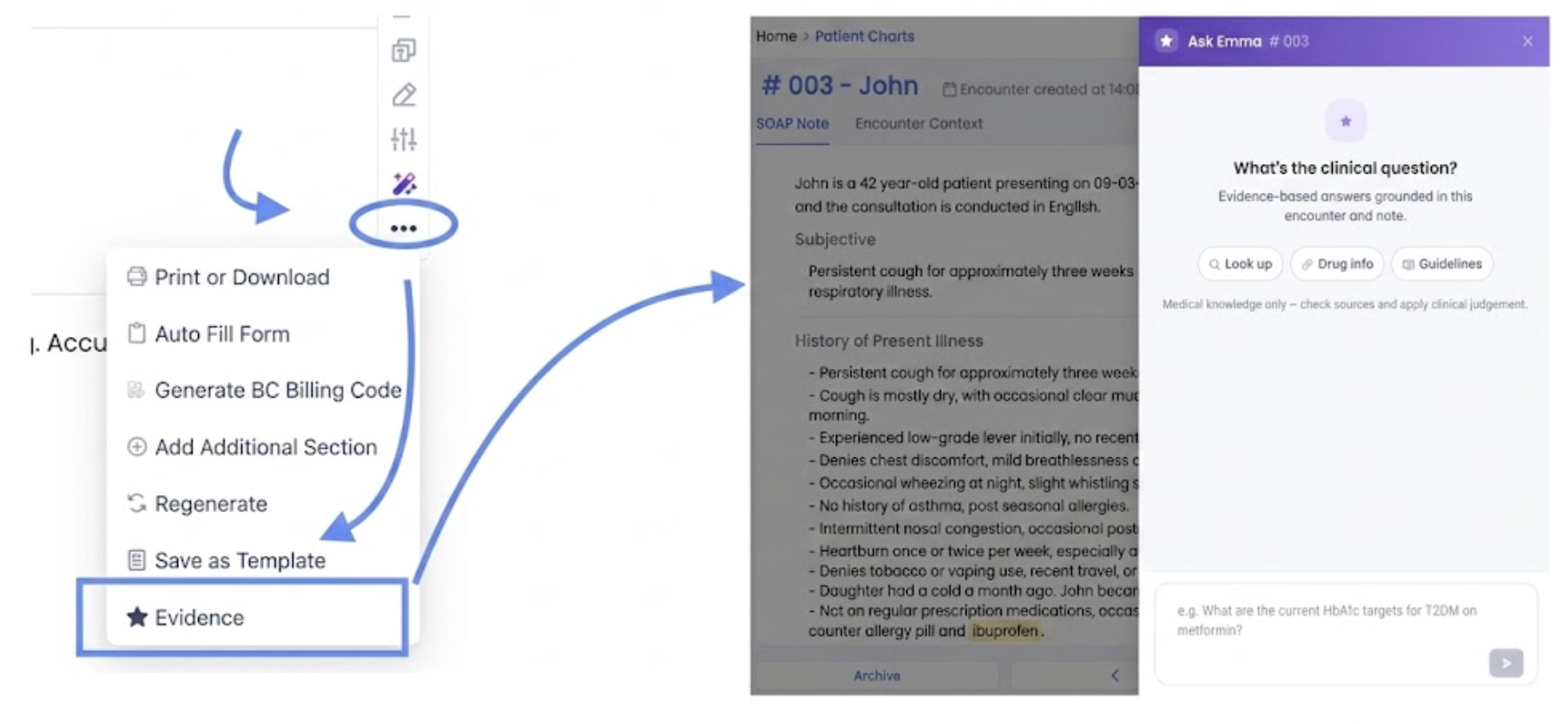
When reviewing a patient encounter, you can access Emma Evidence without leaving the encounter.
Open the patient encounter.
Select Evidence from the vertical feature bar on the right side of the encounter.
The Evidence panel will open alongside your note.
Enter your clinical question.
Because Evidence is opened from within the encounter, it is automatically linked to the patient encounter you are viewing.
This allows you to ask shorter, more natural questions without repeatedly copying clinical information into another tool.
For example, instead of entering:
42-year-old patient with three weeks of cough, mild expiratory wheezing, normal oxygen saturation, no current fever... When should I order a chest X-ray?
You can simply ask:
When would a chest X-ray be recommended here?
Emma Evidence can use the relevant encounter context when generating its response.
Where Emma Evidence gets its information
Emma Evidence is designed to prioritize authoritative clinical evidence rather than general web content.
Sources may include trusted Canadian and internationally recognized medical guidelines and official drug information, such as guidance from organizations including:
Canadian Cardiovascular Society
Diabetes Canada
Thrombosis Canada
Obesity Canada
Health Canada
Relevant international clinical guidance may also be used when appropriate.
Unlike a traditional web search, you do not need to choose which individual sources Emma should search. Emma Evidence identifies and retrieves relevant clinical sources based on your question.
Review and verify the evidence
Emma Evidence is designed to make its answers easy to verify.
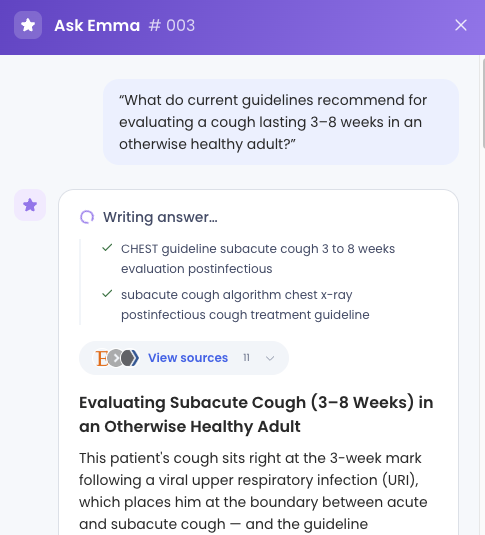
Clinical recommendations are supported by clickable citations, allowing you to review the source behind the information.
When reviewing a response, you can use the citations to identify information such as:
The source or clinical guideline
Publication information
The supporting source content
This makes it easier to verify a recommendation before applying it to clinical decision-making.
Answers designed for point-of-care use
Clinical questions often need to be answered quickly between or during patient encounters.
Depending on the question, Emma Evidence may organize information into formats that are easier to review, including:
Comparison tables
Useful for comparing information such as:
Medication options
Dosages
Renal considerations
Contraindications
Adverse effects
Step-by-step clinical pathways
For diagnostic or management questions, Emma may organize recommendations into a sequence such as:
Step 1: Initial assessment
Step 2: Apply relevant clinical criteria
Step 3: Determine whether further testing is indicated
Step 4: Consider treatment or follow-up
The format of each response will depend on the clinical question being asked.
Clinical calculations
Emma Evidence can also assist with common clinical calculations and risk scores.
For example, you may ask Emma to calculate or help interpret:
Creatinine clearance
Clinical risk scores
Other routine clinical calculations relevant to the encounter
When patient information is available from the linked encounter, Emma can use the relevant values as part of the calculation.
Always review the inputs and calculation before using the result for clinical decision-making.
Tips for asking Evidence questions
You do not need to write a long prompt. Start with the clinical decision you are trying to make.
For example:
Guideline question
What do current guidelines recommend for managing a cough lasting 3–8 weeks?
Investigation question
When should I order a chest X-ray here?
Medication question
Would a bronchodilator be appropriate for this patient?
Dosing question
Does this patient's renal function require a dose adjustment?
Differential question
What diagnoses should I consider based on this presentation?
Follow-up question
What would change the recommended management?
If an initial response is too broad, ask a follow-up question to make it more specific.
Using Emma Evidence responsibly
Emma Evidence is designed to support (not replace) clinical judgment.
Always review the patient's complete clinical context and verify relevant recommendations using the citations provided before making clinical decisions. Clinical guidelines and evidence may also change over time or differ based on jurisdiction, patient population, and individual circumstances.
Emma Evidence helps bring the relevant evidence closer to the point of care so you can spend less time searching and more time evaluating the information in the context of your patient.
Reach out to Support@empathia.ai if you need any support or have any concerns.
Was this article helpful?
That’s Great!
Thank you for your feedback
Sorry! We couldn't be helpful
Thank you for your feedback
Feedback sent
We appreciate your effort and will try to fix the article